Showing posts with label Food. Show all posts

Monday, February 11, 2019

Kuching Escapade Feb'2019

 s
 This posting revives this blog for the year 2019.
On 8 Feb'19 I arrived Sarikei town after a brief stop-over at Bintangor.  At Bintangor I enjoyed the 'Suman Payak', Satay and Teh Tarik before proceeding the journey to Sarikei. Stayed the night at Sarikei and on Saturday left the town on the way to Kuching.
I checked out the Sarikei Central market and found some Illipe nuts sold at RM 2 per small basket.
Illipe nuts sold at the Sarikei Central Market.

Sarikei Central Market

Sarikei Central Market

Wednesday, June 19, 2013

Oil Palm shoots

 In Sarawak there are many species of palm shoots that can be cooked  as vegetables. Among the wild palm shoots that are popular are the Arenga brevipes (Aping- Iban), Eugeissona insignis , Eugeissonia tilis (Pantu - Iban) and Plectocomiopsis geminiflora (Lalis - Malay, Iban). Bamboo shoots are also commonly sold in many 'Tamu' or jungle produce markets.  But today I found one palm species that is becoming easier to obtain its shoots and sold in tamu markets due to its popularity as a cash crop among Sarawak's smallholders.  It is the oil palm shoot ( Sawit - Malay)  as shown in the inset.
A single stem shoot as seen above fetches a price of RM 30 per piece at the tamu market in Bintulu. But some vendors have sliced them up into small pieces to cater for small serving.  A small basket of the sliced oil palm shoots as seen in the inset costs RM 2, sufficient for a serving for two.  One of the most common recipe is to cook it with coconut milk called locally as ' masak lemak'.

Tuesday, March 29, 2011

Images of Bintulu Today

Call it guerilla art, graffiti or street art - these are fluid expressions of urban creative aesthetics. Saw this at the Assyakirin Commerce Square. The graffiti covers part of a wall which hide the municipal rubbish bins. For more pictures of Bintulu's graffiti, click here.
Bintulu's sea sprays are ideal for coastal hibiscus plants. For more coastal hibiscus stories please go here.


One major thing that makes Bintulu a league above other towns of Sarawak is the abundance of fresh fishes at the local fish markets. I'll never miss to drop by at the fish market if ever I'm shopping in town. There's so much unspeakable plain joy in eating fresh fishes be it grilled, BBQ, souped, smoked or eaten raw ( umai or sushi style). Want to know more about fish markets and seafood menu, please click here.

Sunday, March 27, 2011

Wow!! It's the Bintulu belacan

Welcome to Bintulu - home of the best Belacan money can buy.
Two things that make Bintulu international. First, from its seas are exported liquefied natural gas. Second, from its coasts ( see inset) are exported the finest and best quality 'Belacan' or shrimp paste. While in Bintulu, this year opening 'Bubuk' or shrimp season have kept me excited to blog about the making of Bintulu belacan. In a year the bubuk season come twice and the next one would normally be in August. What makes Bintulu belacan simply the best? I think it is the waters off its 14 miles of protected natural park beaches stretching from Likau river to Kuala Similajau river. From its blue and unpolluted coastal waters the local fishermen catch the shrimps in nets and these are immediately brought to town to be sold. Another point worth mentioning is the distinct hot and dry weather here that is ideal for the drying process. Ultimately , I think its the legendary skills of the fishing folks here in the fine art of making the belacan as passed from generations to generations with some recipe kept a family secret. In this blog however I'm about to let some secrets out so that you can try your luck with the smell, the sweat and the blisters or else just fork out RM 60 for a kilo of belacan !. Small fishing boats park nearby the town local market have the shrimps ready packed in ' gantangs'. At the early morning price is inelastic - it's a sellers market. Later in the day when the shrimps are less fresh and the demand less, it's a buyers market. However, when the weather is cloudy or rainy the shrimps can sell much cheaper because there's little sun to help dry them. But then Bintulu's weather is such that when the bubuk season is around there are always days when the sun naturally brings cheer.
Buying 'bubuk' early morning near to Bintulu's tamu or local market.
The season of shrimps in Bintulu has been exceptionally good this year. The fishing folks have been kept busy for a full month now. Before the shrimps land on the negotiation table or roadside market the fishermen have packed them into plastic bags weighing a 'gantang'' which is equivalent to about two and a half kilo. The gantang is always the preferred weight measure for sentimental and traditional reasons, I guess. At the inset is shown the main ingredients for the making of belacan. These are - fresh shrimps, coarse salt, pounded red rice for colouring. The steps in making belacan can be described briefly here. Firstly, the shrimps are marinated with salt and red rice and kept for 24 - 48 hours. Then, it is dried on mats in the hot sun. Next, the men and ladies folks alike pound it into a fine paste. More pictures below.

The dried shrimps are pounded in a special vessel called the ' lesung' which is a wooden mortar. In Bintulu, people prefer to use the mortar from the hardest timber species here called the belian. The 'anak lesung' or the pestle is also made from belian timber as seen in picture above. It takes about 2-3 rounds of pounding to obtain a fine paste of belacan. The pounding process can stretch to several days. Above is the finished belacan product. Each piece is about a kilo in weight and the selling price currently in Bintulu tamu or local market is RM 40-60 depending on quality and availability. Normally for a small family a kilo of belacan will last for about a year or slightly less depending on usage. That's about it folks. If you haven't try Bintulu belacan please do so. Put it in your list of 1000 things to do before you die!

Saturday, September 18, 2010

Serikin street scenes - "Little Indonesia"

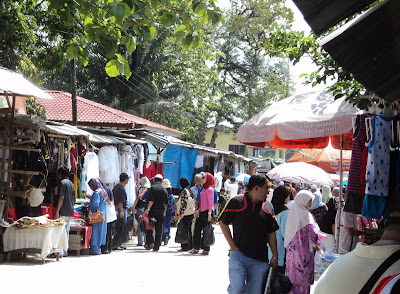
There are hundreds on stalls and the street is crowded with Malaysian shoppers.
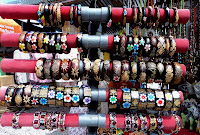
On Saturday we took to the road to visit the little border town of Serikin. It is about less than an hour drive from Kuching city center. The road to Serikin is all paved and is very safe to travel even alone in your own car. Serikin is where Indonesians bring and trade their goods to Malaysian tourists and visitors. It would take about a day or less for Indonesians to travel by road to Serikin which sits on the Malaysian side of the Indonesian-Malaysian boundary line. Here trade in Indonesian made products are brisk and keep on expanding yearly. It seems to me that the place thrives due to private sector dynamism. Indonesians provide the goods that are produced at relatively cheap cost and sold to Malaysians in Malaysian currency. Transaction-wise, Malaysians are bound to benefit due to the high value of the ringgit ( Malaysian currency) vis-a -vis the Indonesian rupiah. At the same time Indonesians find a captive market for their products. But the attraction of Serikin lies also in its ample and wide range of products from household items, personal attire and accessories, food, furniture, handicrafts and souvenirs, herbal medicines, toys, etc. Today the sun was pouring its heat and the tiny road that tugs the stall on both sides were shyed-off by visitors as they preferred to walk under the sheltered canopy of the stalls. Despite the heat I thronged together with hundreds of other eager Malaysians to savour a little of Indonesia. Probably this place may turn out to be " Little Indonesia " in future.
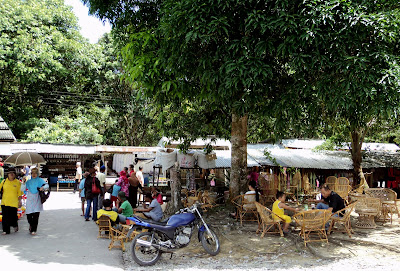

A collection of rattan furniture under shade - book shelf, easy chair, sofa and blinds are available.
Foreground: Rattan winnowing pans, food covers

In Malay or local native culture ( Iban, Bidayuh , Kelabit and other Orang Ulu) the rattan is very much ingrained into their daily lifestyles. Rattans are used for ties or fasteners for scaffolding and timber building construction, strings for various purposes e.g. rafts, carrying baskets for industrial, domestic and personal uses, cultural artifacts, furniture, handicraft or souvenir items e.g. bangles, handbags, food covers, mats, chairs, fish traps,etc. Such is the versatility, robustness, intricate as well as bold applications of this forest plant. ( Inset: rattan mat in cu)
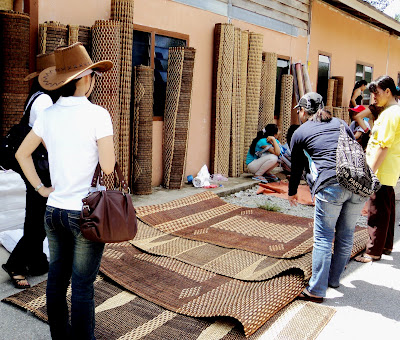
You can be spoilt for choices. Rattan mats of varying sizes, patterns and material mixes ( e.g. rattan plus tree bark) catches up with Malaysian tastes and fads. The prevalence of these mats indicate the richness and sustainability of the rattan plants in Indonesia while in Malaysia these plants are a declining and dying species in large part due to conversion of virgin forests to oil palm plantations and acacia plantations for the production of pulp especially in Bintulu area.
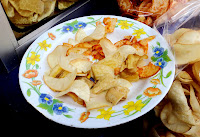

I tried some free samples of chips ( see inset) before I decided to take home a packet of spicy tapioca chips . On the plate were chips from the breadfruit, yam, banana and tapioca. They were all very crispy, tasty ,fried and without any preservatives. In Malaysia now there is a growing interest in the processing of chips as a cottage industry because the rural entrepreneurs produce the basic material plus many of them enjoy some micro -credit assistance from banks and other financing institutions. Many of them are eyeing the export of chips to overseas countries especially Arab nations where consumers are concerned with 'halal' food products and Malaysia is only one of the few Islamic countries that is pursuing 'halal' manufacturing hubs on a global scale. However, for export purposes the products are rigorously manufactured and packaged to meet international standards of quality, safety and longer shelf-life.
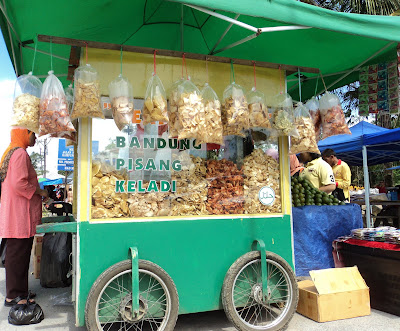
The wordings in Indonesian Malay indicate the type of chips available. "Bandung" is tapioca, "Pisang" means banana and "Keladi" is for yam. A packet above costs RM 5 .

Needless to say, today was a fun outing. A closing chapter for my holiday season in Kuching because come Monday I'll need to concentrate on my assignments and they aren't as palatable as chips.,,think confirmatory factor analysis, structural equation modelling, multivariate data analysis, SPPS... the list goes on and on and on.....Therefore from Monday onwards I'll be more invisible from the blogosphere radar. Bye for now.


Sunday, August 29, 2010

Sunday, June 27, 2010

Green, Green Bintulu.


I am back to the beautiful jungle surrounding of our chalets in Bintulu, something we miss very much in Kuching. We arrived here on the 22nd June around 8.00 pm after a 11 hours journey by road from Kuching city.
The following day I had a walkabout at the farm and was greeted by the fruits of the 'Nangka' ( Jackfruit, Artocarpus heterophyllus) ) that were ripening. It has been about fours years since we planted this tree next to our verandah. It provided shade besides a haven for tree shrews, squrrels as well as birds. The fruits bore marks of being eaten by squirrels. Well, we've been away in Kuching for the last two months and our absence here must have made the squirrels happy with big feasts of the Nangka . We cut open one fruit and the flesh was very sweet, aromatic and crispy. (see inset)
Looking south from our verandah the view was just lovely and very natural. In the picture above the middle ground is filled with scarlet red flowers of the Pagoda flower ( Clerondendron paniclatum) with its typical broad glossy leaves. This is the view when I sit for my afternoon tea by the verandah.
Looking west the jungle remains intact and the island of large trees which were well preserved rose 20-30 meters above our rooftops. Closer to our chalet's back door the long and big fronds of the Bird's Nest Ferns have grown large.
The Bird's Nest fern just outside the back door leading to the garden outside. Below I found the Red Ti ( Cordyline Terminalis) growing luxuriously at the open garden in between our chalets.
I guess I need to cover more grounds at the farm after today and catch up what I miss most of Bintulu - jungle green and fresh fishes.


Saturday, May 15, 2010

Simply Organic and Fresh Meat

Seen at the Satok Sunday Market are these coconut shoots - a kilo costs Ringgit Malaysia (RM) 4.00


At the Satok Sunday market I bumped into two food items- coconut shoots and freshwater clams. Can these two be married? A little imagination would help. Today I'd very much like to try something organic plus fresh meat. Coconuts shoots like the ones above are easily available at Satok. These are freshly cut shoots from tall coconut trees that are plenty around Kuching especially the rural surroundings where they are grown commercially in plantations. Locally these shoots are termed "Umbut".

When old trees are cut, the farmers collect the shoots and bring them to market. In their spare time they may gather clams from mangrove swamps closeby. These big size clams ( Polymesoda erosa) are referred to as " Lokan" in Malay, and are available anytime of the year and sold cheaply at the Sunday market (see inset).
Here's how I would attempt to be imaginative.
Firstly, boil the cut pieces of coconut shoots with other herbs like lemon grass, garlic and chillies for about 10 minutes. Add a half-teaspoonful of salt. In the meantime, get ready the live clams because they come in next. There's a tiny problem. The clams are very difficult to open. Here's a cute trick. Boil them to induce the shells to open up and this process takes less than a minute. How come cooking is so easy?

In boiling water the clam's shell open up effortlessly. Next separate the clam's flesh from the shell with the help of pincers. Put them aside for the next big show in town.

Drop in the clam's flesh into the boiled coconut shoots and continue boiling for another five minutes and no more to avoid the flesh becoming hard and the shoots too soft.
" Waduh !" ( local exclamation similar to Hola ! OMG!) When served hot, the aroma of the herbs combined with the sweet tasting coconut shoots and oyster-like freshwater clams make the formula truly organic and fresh. I love sipping the soup and Oh! so delicious.