
A painting of the rarest of rare orchids from Sarawak -
Paphiopedilum sanderianum.

When I was last in Kuching, I had written about the
new orchid garden that has been added as one the latest tourist attraction to this city. On that visit I had a chance to click on my trusted camera handphone N93i an image of one of the rarest of the rare orchids in the world which was in the form of a painting. It is called the
Paphiopedilum sanderianum ( pronounced "paf-ee-oh-pedilum) as shown in the painting above and a photograph in the inset left. I am amazed to learn that the plant is one of the most sought-after orchids in the world. Its main attraction lies in its flowers which have two wavy drooping petals that can reach more than three feet length! It was discovered by a German collector (J. Forster-mann) who scoured the Sarawak forest in 1885. It was then "rediscovered" in 1978 by botanist Ivan Nielsen who found it flowering near Fire Mountain in Sarawak's deep interior.
Recently I got hold of a book on orchids entitled " Orchid Fever" written by Eric Hensen bought at a local bookstore in Kuching. The first chapter of the book focused on this endangered orchid species. Well more than that. In 1989, the sanderianum was up in the CITES list of the most endangered species in the world. And what does that mean? Caught taking it out of Sarawak or into any other signatory countries of CITES one can be fined as high as US$ 500,000 plus ten years in jail!!!
The book further described of an adventure into the impenetrable tropical rainforest of Borneo, near the Fire Mountain or what the
local Penans called " Gunung Api". The expedition took on a ten days round trip just to see the sanderianum flower in the wild i.e. in its natural state. Having reached the holy grail of orchids, Eric Hansen wrote:"We climbed to about 950 feet, where we were surrounded by hundreds of sanderianum plants. It was difficult to move around for fear of trampling on the orchids, so we stood still for a moment savoring the incredible sight of these pristine wild plants. Only a handful of people on earth had ever seen what lay before us.
"AGGGGGH WHERE THE HELL IS MY GOD-DAMN HIGH -SPEED FILM?" Donald screamed into his camera bag before dumping its contents onto the ground.
Once the two men had calmed down, they swung into action while Bati, Katong, and I sat to drink in the scene of orchid ecstasy. Motor drives whirred, leaves were measured ( 3 inches across), mature plants, seedlings, and seed pods were counted, rain water was tested (pH 6.3), light was measured in units of foot-candles (2,500 to 4,000), and samples of rock (pH 7.5) were tested. Four hours later we were on our way down the mountain with notebooks full of data. Over the course of a week, we returned to the site several times, and then moved on to discover thousands of sanderianum plants in dozens of different sites."
The above expedition was in 1993 and in a light-hearted manner, Eric wrote towards the end of the chapter:" I was surprised when Richard told me that this sort of independent research, without special permits from the host country, is also prohibited".

A view of the new orchid garden ( DBKU Orchid Garden) towards the newly completed Sarawak State Legislative Assembly building in the far background.
 Grammathophylum speciosum
 ( Tiger Orchid) - the biggest orchid in the world
dispalyed at an open area in the orchid garden compound.
The Tiger Orchid is an epiphytic orchid and grows naturally in Sarawak on the crowns of tall trees. However it can also be grown on the lowlands for example in town or city residential gardens. The handsome sample above can be seen at the orchid garden. I'll look forward to see when it will flower in future, which happens only once a year displaying lovely masses of golden yellow and spoted orange petals.
To me then, the sanderianum and the tiger orchid are one of the many of Sarawak's gifts to the world .
Ref: Eric Hansen (2000 ) Orchid Fever, Methuen Publishing Ltd, London.


 The Normah Orchid ( Phalaenopsis bellina) - is fragrant and is the state flower of Sarawak.
 The " Lady Slipper Orchid" ( Paphiopedilum spp.) is one of the most sought after native orchid species of Sarawak. Its resemblance to the slipper or Chinese tongs is clearly seen in the above picture. Note the labellum ( lip) which takes the form of a shoe-shaped pouch.
 DBKU Orchid Garden , Kuching, Sarawak.
 Orchids have many uses apart from giving us much aesthetic pleasure. Orchids are grown for medicinal and culinary reasons. The well -known Vanilla Orchid ( Vanilla planifolia) produces vanillin used to flavour chocolate, ice-cream and cakes. The bulb of Arethusa bulbosa, a Japanese orchid is a good remedy for toothache. In many countries the orchid nurseries and gardens are important places to visit for tourists and orchid enthusiasts who come from far away destinations. Orchids arrangement make delightful table pieces, bouquet, corsage or 'bridal guard'. It is a thing of beauty that always brings us joy. ( Inset: Laeliocattleya 'Dorset Gold')
 An orchid garden display setting at the DBKU Orchid Garden, Kuching.
 Displaying orchids in towns or residential areas require a little bit of understanding on the requirements of these unique plants. Generally, species collected from cool altitudes do not grow well in hot lowland regions. Thus the environment may need to be modified by locating them in shaded or cooler areas of the garden. Other species can be displayed in a rockery concept as shown above and below. The Spathoglottis species are terrestrial or ground orchids and growing in limestone hills they are suitable specimens for garden rockeries. The most common of the Spathoglottis species is the Spathoglottis plicata and since they have been in cultivation for quite sometime, they are now available in colours of yellow, pink, purple or mauve and white and also combinations of yellow, orange and purple.
 Spathoglottis plicata in various hues - yellow and purple, placed amidst rocks and an artificial stream for its modified environment.
 Cut tree trunk acts as supporting structure for the orchids to get attached .
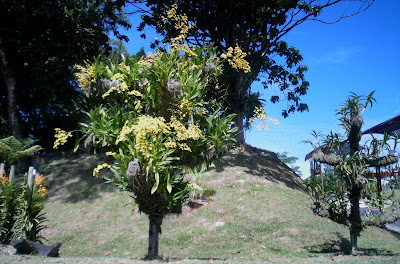 Heavy flowering of the "Golden Shower" (Oncidium 'Goldiana' ) on a 'dummy tree'.
 Phalaenopsis cornu-cervi with healthy roots.
 Beautifully grown light purple Dendrobium orchid on a 'dummy tree' of belian wood wrapped with coarse coconut husks.
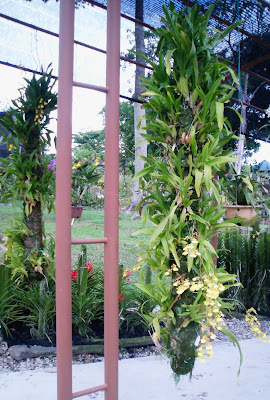 Suspended 'Belian' posts are useful when we need to move the orchids often to various locations around the house or garden. Like planting on dummy trees, the roots are attached to coconut husks or flattened stems of tree ferns and best fastened using nylon strings. Avoid using wires for tying because they rust and could be harmful to the roots and pseudobulbs. Select suitable orchid species that are epiphytic as they have roots that are well modified to enable them to hang in the air like the Oncidium species above. Oncidiums have flowers in a spray and it is the tiny golden 'dancing ladies' that make them attractive. Now Oncidiums are hybrided and come out in many new colours of rosy pink and purple from the familiar yellow.In Sarawak the most commonly grown hybrid is the Oncidium 'Goldiana' or "Golden Shower". There are also miniature oncidiums in the market. Oncidiums perform better in bright environment and some can take to full sunlight.
 Big clay jars are ideal for large- sized orchids, above and below set in an orchid enclosure. The shelter is usually lined with netting to prevent the plants being scorched by direct sun rays.
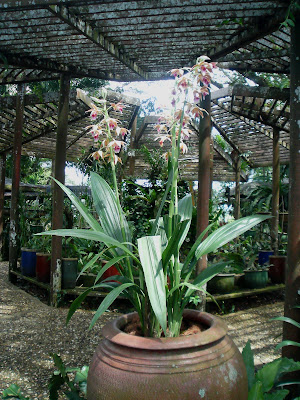 Phius tankerville
 Dendrobium secundum
 Phaius tankervillae
 Spathodea campanulata (African Tulip tree)
 Coelogyne pandurata
 Phalaenopsis cornu-cervi
 Plumeria rubra
 A painting of the rarest of rare orchids from Sarawak - Paphiopedilum sanderianum.
 A view of the new orchid garden ( DBKU Orchid Garden) towards the newly completed Sarawak State Legislative Assembly building in the far background.
 Grammathophylum speciosum ( Tiger Orchid) - the biggest orchid in the world