Friday, September 13, 2013

ONCE UPON A RADIO

Picture above is taken from a tiny book about Sarawak entitled " Memperkenalkan Serawak",
written by R.M. Jasmi and  published by Sinaran Bros, North Borneo in 1958.
The picture shows the Sarawak Radio Building which produced and broadcasted radio programmes and also radio lessons for schools throughout Sarawak.  The broadcast reached Bintulu in fairly clear reception in 1963.


EMS ( Educational Mass Media Service )
Building in 1970's.  During colonial time
the building was called 'The Pavillion'.
 Just months before Sarawak became independent from the British colonial government and its forming the Federation of Malaysia on the 16th of September in 1963, I was a Primary Six student at St.Anthony's School, Bintulu. During those days the whole school curriculum was taught in English.  But the learning of English did not end in the classrooms. I participated in the school drama called 'The Black Basin', sang songs and debated in English.  It was really nostalgic for me to know that 16 years later I was to head the Educational Radio section of the Educational Mass Media Service arm of the Sarawak Education Department in the years 1978 -1979 in Kuching, the capital of Sarawak. .  At the inset is the picture of my office while I was in charge of the school's broadcasting programmes.  I occupied a big room at the building and from it our radio producers created radio programmes in many languages like English, Malay, Chinese and Iban for schools in Sarawak. In 1963 however I was very keen to write to the School Broadcasting Officer to inquire about many general knowledge questions.  I wrote four letters and below is one letter I received from Alan Moore dated 1st July,1963.  In those days, primary school students really looked forward to listening the  radio lessons broadcasts to learn how to speak the language correctly and listened to the replies of their letters on air from Kuching.


Above is the broadcasting schedule of the school's broadcast in 1979, days of broadcast and time of broadcast included
Note the subject "Anna and Abu" - this was the broadcast for the learning of English for Primary 5 students, produced by Reg Salisbury, a Colombo Plan expert for the teaching of English through radio..


Picture shows Reg Salisbury taken by me while having lunch at a food stall in Miri.


During my short stint at the Educational Radio I was most fortunate to work with Reg Salisbury who was from the BBC and acted as a Colombo Plan expert in the teaching of English by way of radio lessons.  We went around Sarawak to promote the 'Anna and Abu' programme together with printed teaching aids to teachers as remote as Bario in the Kelabit Highlands and little known places like  Awat-Awat near Limbang.
While working together in Kuching I managed to get Reg Salisbury read my poems and recorded them in the studio of RTM (Radio and Television Malaysia) in Kuching.  Here is one of my poems read by Reg Salisbury called " Hasyimah"....of which I think the BBC voice is just superb.  Check out the reading here...>>>> http://www.youtube.com/watch?v=4DireBC97YI

Happy Malaysia Day Sarawak!!


Monday, September 2, 2013

ONCE UPON A SOUND

Sarawak sapeh players from an old post card.

Batik by MOOD
 A long time ago the sounds of the sapeh were heard deep in the interior of Sarawak.  It has an exotic and mystic sound to it having the power to mesmerize the listener.  Nowadays the sapeh music is a tourism product that sells well for Sarawak.  I am always entertained to its music which reminds me of my school days at Tanjung Lobang Miri in the 60's where the rural students mainly from the ethnic groups like Kelabit and Kayans were greatly encouraged by the Principal of the school/college (Mr. Robert Nichol)  to bring the sapeh to school and play in many of the school functions.  From such exposure I have on many occasions painted the sapeh players and dancers for my batik pieces.
Sapeh music accopanying a Hornbill dance
Batik by MOOD

A sapeh player basking at the Kuching waterfront...
Sometime ago I made a simple recording of two sapeh players in Kuching using a Nokia camera phone N93i.  I am indeed surprised to see that as at today that recording has received more than 29,500 views. The link to the video is here...>>> THE SOUNDS OF SARAWAK SAPEH

Sarawak is indeed blessed with such a rich diversity of culture and ethnic groups with their unique music.
Happy Malaysia Day Sarawak!!

Monday, August 19, 2013

Coastal greenery at Sematan

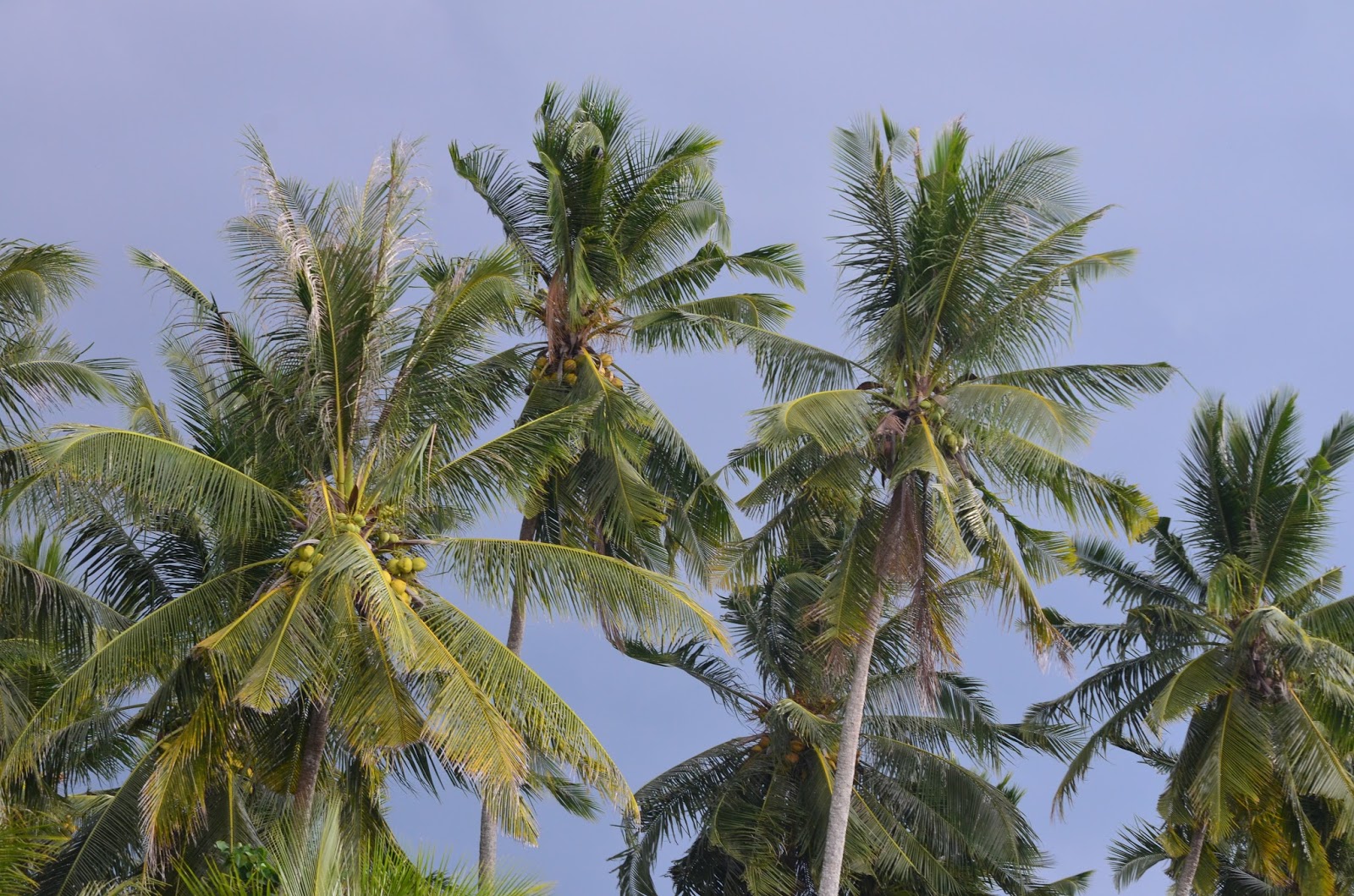
Long stretches of beach are fringed with tall Ru and coconut trees

Ru tree visited by a colourful bird.
 On a recent visit to Sematan, I watched long stretches of wide sandy beaches portraying the tropical look of swaying coconut trees and greenery.  The casuarina trees are called "Ru" in Malay.  These trees and the coconut palms dominant the coastal greenery but below them are a rich diversity of flowering shrubs. Of interest are the Sea Hibiscus (Hibiscus tiliaceus), Sea Lettuce (Scaevoda taccada)  and the Sea Ox eye (Wollostonia biflora).  On the sandy ground floor I noticed the Common Morning Glory ( Ipomoea purpurea) and another vine that is new to my eyes.
Typical coastal vegetation fringe ...large and tall Ru trees and shrubbery below and vines on the sandy beach floor
Ru (Casuarina equisetifolia )
Family : Casuarinaceae - Casuarina family

Young Ru treelets grown from its 'fruits' which are cones, although cones are not fruits.

Coconut trees (Cococ nucifera)
 I love to see swaying coconut leaves but I love most its young nuts opened and drinking its refreshing coconut water.  I was particularly fascinated by a small flock of parrots that fly to a tall but dead coconut trunk.  They seemed to be using the top of the trunk to clean their beaks.

 Three flowering shrubs or rather small trees that are abundantly free-flowering are the Sea Hibiscus, Sea Lettuce and Sea Ox eye.  The Sea Hibiscus has bright yellow flowers that gradually turn pink during the day ( see inset).
Sea Hibiscus (Hibiscus tiliaceus)
Family : Malvaceae - Hibiscus family


Sea Lettuce (Scaevoda taccada)
 The flowers of the Sea Lettuce look like half-flowers.  Its 5-lobed corolla is completely split down in its upper side and flared out like a fan.
Sea Lettuce (Scaevoda taccada)
Family : Goodeniaceae - Goodenia family

Free-flowering low shrubbery - Sea Ox eye ( Wollastonia biflora)

Pokok Serunai (Malay) - Wollastonia biflora
Syn : Weedelia biflora
Family : Compositae - Sun flower family


Common Morning Glory (Ipomoea purpurea)
Family : Convolvulaceae - Morning Glory family
 On the sandy floor I saw the Common Morning Glory.  There is however another plant that is uncommon to my eyes.  It has purple flowers that look more from the sub-family Papilionoideae, with flowers closely resembling the Clitoria ternata or the Butterfly pea but leaves of the Morning Glory.  Its pod makes it under the family of Leguminosae or Bean family which is further divided into the sub-families - Caesalpinioideae, Mimosideae and Papilionoideae.  Peculiar to the Papilionoideae, the upper petals stands out by its larger size and different shape with the two lower petals  united.